

kings, what a good idea!
i think A Drop of Corruption argues for the thing A Tainted Cup argued against, and i’ve been trying to work out whether i’m being unfair

warning: spoilers for The Tainted Cup and A Drop Of Corruption but not for A Trade of Blood (for real, i haven’t read it yet).
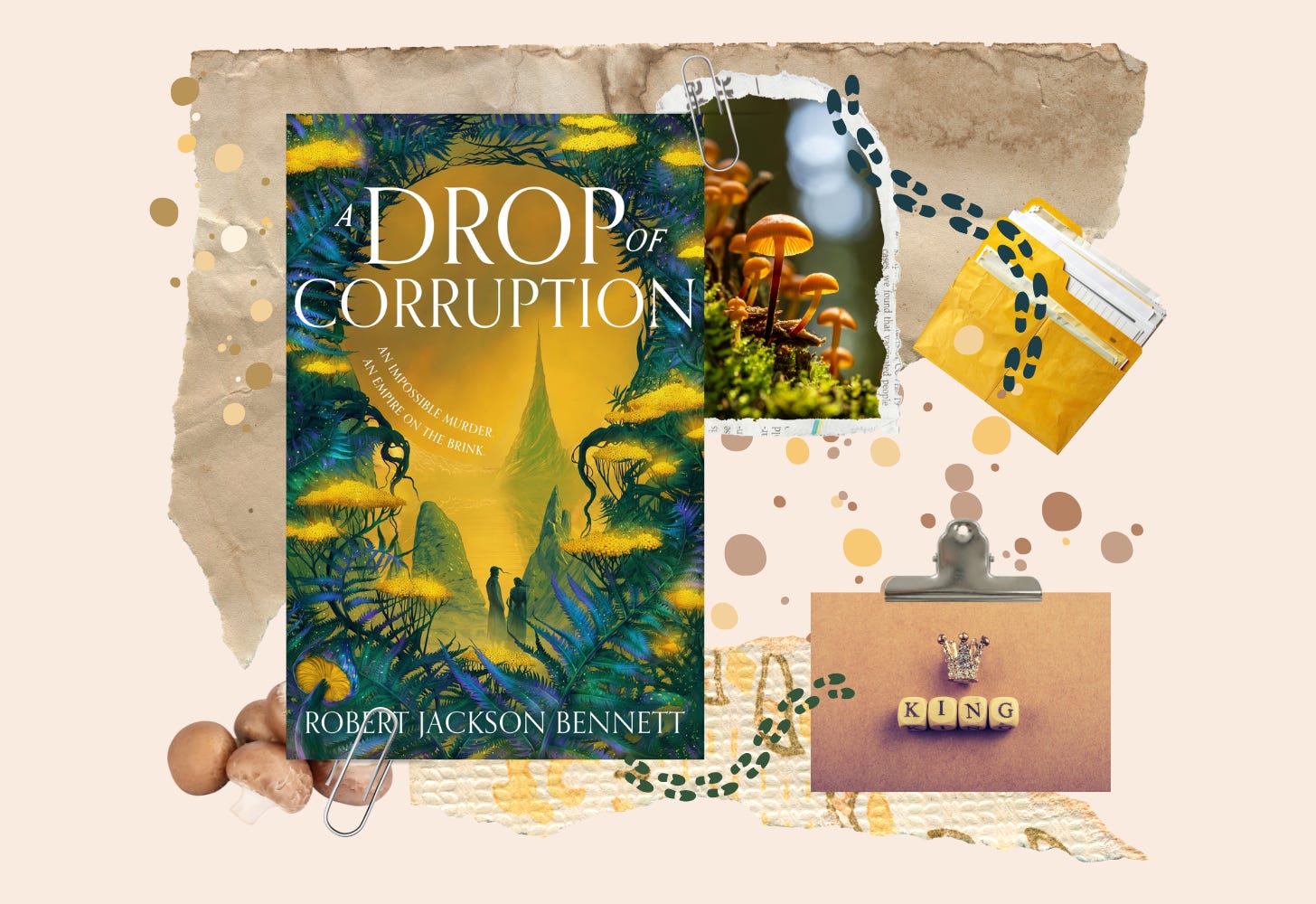
I loved The Tainted Cup. It’s one of those books I finished and immediately wanted to press on people — a locked-room murder in a world where the magic is all fungal and a bit disgusting, solved by a blindfolded detective who’s cleverer than everyone else and narrated by her assistant, who can’t forget anything he smells. I took a while to buy the sequel, A Drop of Corruption because of finances more than anything else (well, also the fact that there was no cliffhanger, i like that). A Trade of Blood (book 3) comes out later in August, and I finally sat down fully expecting to love it just as much. I kinda did, for what it’s worth.
The thing that complicated it for me was the author’s note. Bennett ends the first book with this author’s note on autocracy:

It’s not always that a fantasy author comes right out and names the real, current, political thing they’re fighting against in the back of the book, and given when I happened to be reading it (2026), it felt even more pointed than at publication time (2024) (Bennett is a USA author) (if you need more context than that, i can’t help you, sorry)..
And then I kept turning it over, and I started to feel like the sequel might not quite be doing what the note says it is. This is the part I’ve found hard to write, because I don’t think Bennett is secretly an autocrat-loving asshole, and I don’t think the book is bad. But the more I sat with it, the more it seemed to me that A Drop of Corruption spends a lot of its four hundred pages making autocracy look pretty good. It keeps setting up kings to knock down and then not quite doing so.
I’m not the only one who came away a bit itchy about the politics. A couple of reviewers noticed it too: this post was spurred from reading Evie Bee Reads’ listing of the colonial references. I also recommend Jen K’s review for Cannonball who had the same lurch I did when it turned out the empire was the lesser evil.
I had some other thoughts to add to that. Starting, I suppose, with the detective.

starting with Ana

The odd thing about these books is that Din narrates them but Ana is the one you’re supposed to be admiring. He does the actual legwork, the trudging through random places, the getting hurt, the actual clue-gathering — while she sits behind her blindfold and turns out to be right. Not right after a couple of wrong guesses, which is how I tend to think of most fictional detectives, but right pretty much from the get go. She solves the murder, obviously, but she also solves Din – more or less. She helps him understand his doubts and all the things he can’t work out for himself about his life. Whenever something needs figuring out, whether it’s the case or the person, it’s Ana who does.
I didn’t really notice this was bothering me until the end, when the book has its grand reveal: that Ana is the product of an Imperial programme to recreate the lost (superior) race of the Khanum. So it’s not just that she’s gifted or autistic, or whatever it is that Columbo has.
The person I’m being invited to admire more than anyone else in the book is admirable, partly, because she’s a step closer to a vanished race of superior people, who also happen to have built the Empire. She’s clever and trustworthy partly because of her blood. For a book whose author’s note is trying to tell me bloodlines shouldn’t decide who’s in charge, I found it a little strange that its cleverest, most reliable character is basically a demonstration that sometimes they do.
To be fair, Bennett clearly sees this coming, because he gives Ana a speech about more or less exactly. It’s a good speech, and I don’t doubt he means it, I just don’t think a speech quite undoes the whole story quietly showing me that her gifts are real, her judgement is sound, and things generally go better when she’s the one who knows best.
Which might not matter much if it were only Ana. But it isn’t only Ana.
the Yarrowdale problem

The engine of A Drop of Corruption is an annexation. Yarrowdale’s a small independent kingdom at the edge of the Empire, and over the course of the book the Empire is slowly absorbing it, using a treaty signed a century ago. Nobody in Yarrowdale is being asked whether they want this. Which, again, seemed to me like a good setup for an anti-empire book. Here’s an empire doing the empire thing!
Except I kept being handed reasons the annexation might be, on balance, alright. Yarrowdale turns out to be a fairly grim little feudal place; and the Empire shows up with all the good things: medicine, infrastructure, the biological marvels, the seawalls that stop everyone getting eaten by the mean monsters. It’s framed almost as a rescue, or at least a favour.
They were backward and we brought progress is a thing colonizing powers have always said about themselves, and I don’t think it stops being that just because there’s a real threat involved – “modern” medicine certainly saved a lot of people irl, but slavery and genocide killed a fuck ton more.
Bennett tries to say in his author letter that he changed the kingdom of Yarrow into a high fantasy realm, after seeing this pitfall, but to me he didn’t go far enough. It’d be one thing if I got a replica of Rivendell with thriving arts and magnificent architecture, with educated people; but Yarrowdale is still described as a backwater swamp with rotting castles and dirty people lining the streets who tend to worship outsiders as gods.
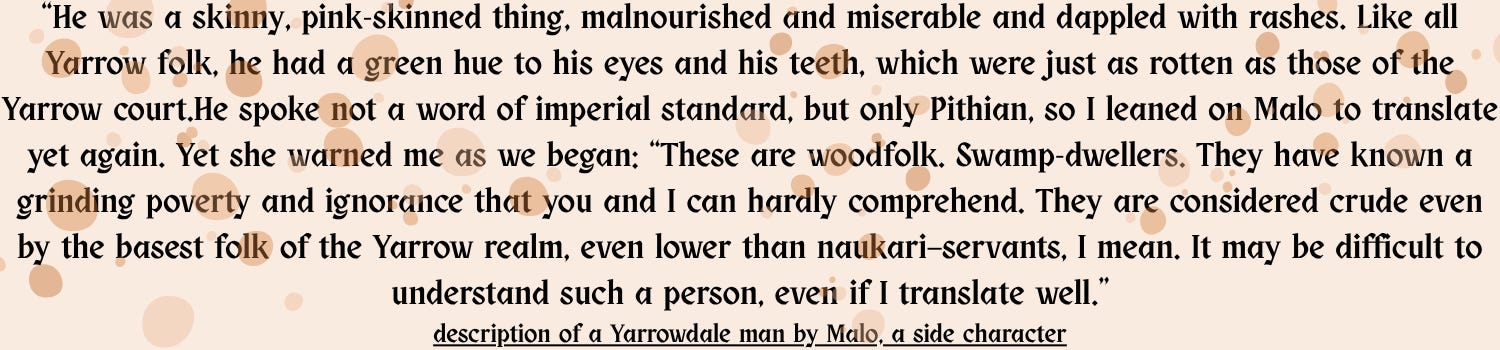
Now, a genuinely rotten monarchy still doesn’t hand a bigger power the right to walk in and take it over, but maybe the point would have been better made otherwise. The book is very good at distrusting that story when the Yarrowdale king is the one telling it. I’m less sure it noticed it was telling a version of it about the Empire.
Making the monarchy look nicer wouldn’t really make the book less pro-empire, as far as I can tell (can you be anti-empire and pro-monarchy? Seriously asking. As a French person, I default to guillotining everyone). A gorgeous High Fantasy kingdom being folded into a sensible modern bureaucracy still lands, for me, as “the pretty old thing gave way to the practical new thing,” which is more or less the annexation’s own pitch. There’s a late suggestion that the Empire means to withdraw eventually but it comes so late, and so quietly, that I didn’t feel it shift much.
Which brings me to the villains, and what felt like the biggest missed opportunity.
the villains
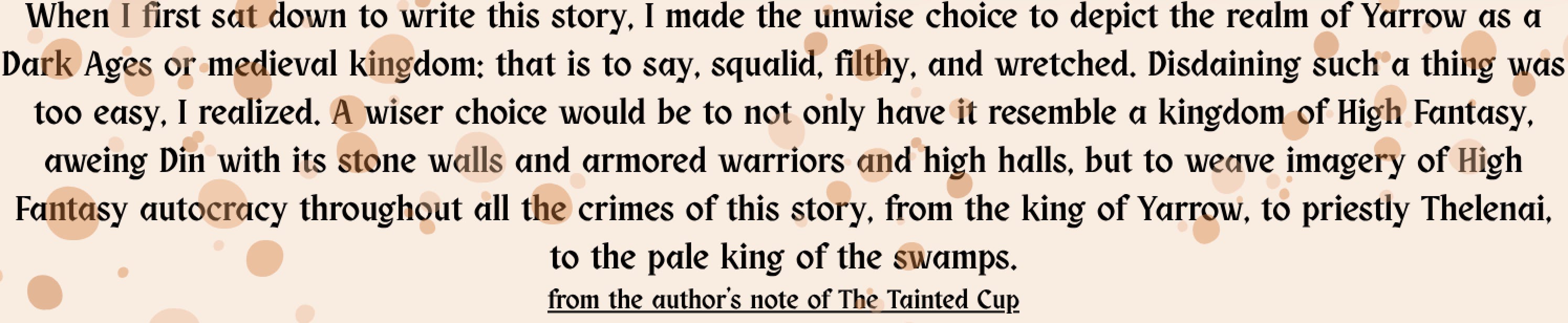
In the note1, Bennett says he wanted to weave the (inexistent to me) High Fantasy autocracy imagery through the crimes, which is a nice plan — villains are a decent way to make a point about a thing! You attach the thing to the people doing harm and the reader recoils from both. But for that to work the villains have to actually be the thing, and Bennett’s autocrats aren’t doing that much crime and oppression.
Take the obvious one, the King of Yarrowdale. For a little while he’s the perfect suspect — an actual hereditary monarch, hanging onto power, clearly the sort of man the book wants to be against. And then he gets killed off fairly quickly by the real culprit, because in a mystery the obvious answer can’t be the right one. By the time he dies, though, we’ve learned he’s old, half-senile (if not entirely), and definitely not up to much deceit anymore.
His one genuinely dodgy act is a scheme from years back to evict the Empire – great! Except that’s not a crime we can hold against him if we want to write an anti-empire book! So his big crime is muddy, and old, and mostly by the end he’s a frail old man who got murdered. Sounds more like a victim than a real big-bad-monarch.
Then there’s the actual villain, the pale so-called king out in the swamps — except of course, he’s a usurper. He’s not a rightful king, which means the unease we’re meant to feel about him grabbing at a crown he “shouldn’t” have sort of relies on there being a crown someone should have, by birth. On top of which, the book makes him a little sympathetic by showing that monarchy is partly what wrecked him in the first place.
So the Pale King standing in for “autocracy” in the swamps is more like someone autocracy chewed up, who now wants his turn at it. He even says something to Ana along these lines (”you disdain kings, but I know what you are!“) — and, honestly, he’s got a point. He’s clocked more or less the same thing I did: for all the anti-king talk, the story keeps bowing to a certain kind of superior person. It gives me a bit of pause that the sharpest line about the hero’s blind spot comes out of the villain’s mouth.
Finally, there’s Commander-Prificto Thelenai, a character who gets some queen-ish language draped over her – but she’s not an autocrat either. Without spoiling you the ending, she’s an imperial official who bends and breaks the rules – for the greater good though, and the book lets her be right about it. So even the character meant to nod at bureaucratic overreach ends up quietly suggesting that a capable person willing to get her hands dirty gets things done for the greater good — which, again, isn’t quite the moral I think was intended.
I don’t want to over-reach, but there did seem to be a pattern. Everyone meant to carry the anti-autocracy weight either isn’t really an autocrat, or is too sad to properly convict, or actually saves millions of people while only hurting a select few who volunteered.
Which brings me, finally, to the top of the whole thing — the one autocrat the book can’t turn into a victim, because he’s doing rather well.
the man on the coins

Everything so far, in fairness, is the kind of thing A Drop Of Corruption added, maybe mistakenly (it’s a good pun though, it added a drop of autocracy is good to an anti-autocracy book). But the whole world, from the first book onwards, is built around a good emperor – so this anti-autocracy project was doomed from the start.
The books more or less makes its case for the Emperor. The seawalls, the literal thing keeping everyone from being eaten, are his. “You are the Empire” is the motto they tell the people. It can be genuinely stirring; it also happens to be the move I associate with real strongmen — I’m not above you, I am you, I’m the nation.
There’s an effort to take the edge off this with a bit of a democracy story: the emperor, we’re told, gave his people their institutions — handed down a senate, out of his own good nature. But the senate doesn’t seem to have all that much actual power, and I found “the all-powerful immortal ruler kindly decided to share a bit of it“ a hard sell as a democratic origin story. It reminded me more of the emergency-powers thing, where the strongman will absolutely give it all back once the crisis is over, except somehow the crisis never resolves itself. Rulers voluntarily handing back real power isn’t something I can think of many examples of. Building the world on the idea that this one did, and that it was rather lovely of him, sat a bit oddly with me for a book that wants me not to trust rulers.
And final straw for this Emperor: he’s good at it. He’s the last of the Khanum — the same better blood that makes Ana the cleverest person in the room — and by the book’s own account he’s run things capably for four hundred years. So the world ends up containing a living example of the exact thing the note is asking me not to believe: that one genetically superior person really can be uniquely suited to ruling, and really can pull it off, for a very long time. The note says autocrats are, when it comes down to it, only men, subject to the same mortal rules as all of us. And this book sort of replies: yes, but have you met this one.
The book seems to feel the tension, because it reaches for a couple of fixes near the end — a suggestion the emperor’s stepped back from power these days and a hint his past wasn’t spotless. But they felt like small touches to retcon a big structural problem. I don’t think you can spend a series making a benevolent immortal genius-king the reason your world is still standing, and then quietly turn the wheel towards “anyway, down with kings.” By that point it’s a bit baked in.
anyway, my rant is over

I do want to be fair to Bennett here, partly because I think what happened is genuinely hard to avoid, and it’s bigger than his book. That Pratchett line he quotes, about the blank spot in our heads marked kings, what a good idea — the joke of it, the reason it’s funny, is that Pratchett was talking about himself too. And so am I, and so is Bennett. Fantasy runs on kings and chosen ones and special blood; it’s a huge amount of the furniture, and it’s there because some part of us likes it, however much the more sensible part knows better. The two are more or less always pulling against each other, we’re the ones who keep filling in that blank spot, book after book.
So I don’t really want to land on “Bennett failed,” which feels both unkind and not quite my place — I’m not going to sit here and tell him how he ought to have built the thing when I can’t even finish a short story to save my life. And I should be honest that I’m not sure I’d have clocked most of this on a first read if it weren’t for that author’s note. I remembered how sharp it felt from the first book – so much so that I re-read it – and then I think I spent A Drop Of Corruption half-waiting for the story to be as brave as The Tainted Cup’s afterword. If the note hadn’t promised me quite so much, I’d probably have just enjoyed a very good murder mystery and thought no more about it. So maybe the disappointment is mostly the size of the promise.
But the thing I’ve actually taken from it, as someone who reads a lot of this and would very much like to write it well, is smaller and a bit more uncomfortable: it’s really quite hard to put kings and queens and special people in a story and not, somewhere along the way, end up on their side a little. A good afterword doesn’t do it on its own. Whatever you put in the speeches, the argument sort of lives in the other stuff — in who turns out to be right, who gets rescued when it counts, whose blood matters, who’s still standing when the water comes up. You can mean the exact opposite with your whole heart and still, if you’re not watching all of that, hand someone a world that quietly goes kings — what a good idea. Bennett meant it as a warning. I came away reading it, a bit uneasily, as the reverse. And the fact that someone this thoughtful and this deliberately anti-king could still end up here isn’t really a mark against him. If anything it’s the most convincing case for the note’s own point. That’s just how strong the pull is.
I’ll still be first in the queue for A Trade of Blood in August, some blank spots you don’t get to opt out of. But if it turns out to just be another detective story without at least trying to change course on the anti-autocracy things, then I think I’ll stop the series there, sorry Robert.
Read you next time,

Did you have the same anticipatory expectations as I did? Please don’t spoil A Trade of Blood in the comments, I haven’t read it yet, but do tell me if it gets better on that front!
Also, do you recommend his earlier series, Foundryside? Or will I be disappointed too? I loved his world building so I kinda want to give it a try!
Do you have 10 more minutes to read another essay? Here are a few recommendations:



I can’t tell if he means that he saw what the wisest choice would be and decided not to take it, crippling his message; or if he means he saw the pitfall and avoided it by doing edits (in which case i think the edits failed)