

the wild horse, the remote control, and what films leave behind
part one of a series about babysitting, children’s films, and (sort of) the end of the world

This post might cut off in your email client so click on the title to open it in the app or your browser. Also, I use a lot of footnotes: on desktop you can hover to read them, and on mobile click on the number to be brought to the footnote, then click on it again to be brought back to where you left off in the main article.
I did not set out to write about children’s cinema; i set out to survive August.
I’ve been babysitting my little cousins—six and eight years old—for most of the summer, and I like it, mostly. On the days the heatwave allows, our mornings are spent running around the playground; on the others, we read, sometimes side by side, sometimes out loud. But after nap time, I let them watch a whole film, beginning to end.
It’s almost certainly too much screen time for their age, and their parents kind of mind, but my own happiest memories are exactly this: the films my parents wouldn’t have allowed, consumed in one unbroken sitting. I’m just trying to give them the childhood I got!1
Now, I’m fully aware that having opinions about children’s media from the comfortable position aunt who supervises for a few hours is a little bit, well, precarious. But the parents do trust me with the remote, even if they wished I broke it up in 30 minute chunks.2 Anyways last Wednesday I put on Spirit: Stallion of the Cimarron – my favorite film in the world when I was their age.3
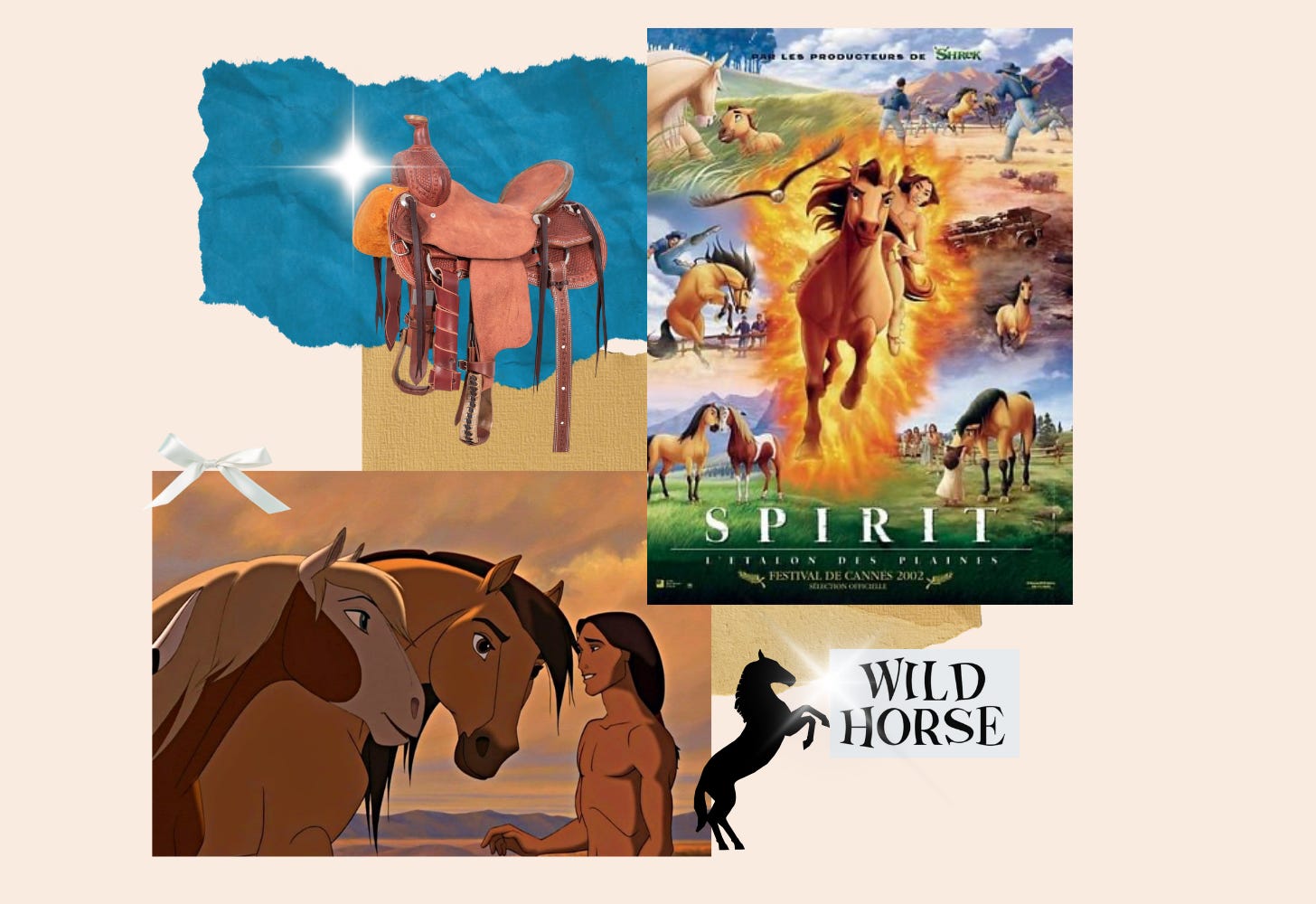
the horse
If you didn’t grow up with it: Spirit is a 2002 DreamWorks film about wild mustangs in the American West. Spirit lives peacefully on the Great Plains before he’s captured by railroad expansionists. They try to tame him brutally to get him to haul a locomotive up a hill, but Spirit rebels and derails it instead. Adventures ensue, including a huge canyon leap, a waterfall drop and a love story with a lovely mare named Rain.
Watching Spirit, l’étalon des plaines4 on a much smaller sofa at eight years old, I felt something go off in my chest and immediately demanded horse-riding lessons.5
I hadn’t seen the movie in maybe twenty years. The little cousins were skeptical for the first ten minutes—animals that don’t talk are a hard sell in the post-Zootopia economy—but then they went dead still during the escape sequence.
Spirit is still so strongly in me two decades later, and I felt so strange watching them get roped into my old favorite. It made me realize that whatever I put on the TV will still be in their heads in 2046, when they reach my age6. I’m smuggling the foundations of their future adult heads – and I’m sure it’ll take a much stronger hold than what their parents show them, if only because they get to experience the full thing from start to finish.7
We had an interesting talk about animal cruelty and why anyone would ever want to inflict that much pain on another being, and finished the afternoon with a re-read of The Little Prince to compare Little Creek’s actions with the Prince’s when taming his fox friend.
the philosopher (sorry, but i read things when i’m anxious)
Things == philosophy, mostly, which might be marginally worse than computer science papers.8
Down a Google Scholar rabbit hole, I found Martha Nussbaum. She argues that a child doesn’t reason their way into morality; they feel their way in, mostly through stories. You don’t hand a small person a textbook definition of cruelty, instead you give them a character to identify with and let their empathy do the work. It sounds incredibly intuitive once you hear it: we’ve always been teaching morals and ethics with stories, whether they be folk tales or the Bible.
As children grow older, the moral and social aspects of these literary scenarios become increasingly complex and full of distinctions, so that they gradually learn how to ascribe to others, and recognize in themselves, not only hope and fear, happiness and distress – attitudes that are ubiquitous, and comprehensible without extensive experience – but also more complex traits such as courage, self-restraint, dignity, perseverance, and fairness. These notions might be defined for the child in an abstract way; but to grasp their full meaning in one’s own self-development and in social interactions with others requires learning their dynamics in narrative settings.
For some reason, I never fully realized that movies aren’t just entertainment but also a moral education. Sure, I know to avoid the old racist cartoon, or to explain that you should definitely ask someone before kissing them, but the subtlety of this argument hadn’t hit me when it comes to depictions of nature and climate.
Stories can then begin to confront children more plainly with the uneven fortunes of life, convincing them emotionally of their urgency and importance. [...]
Rousseau writes of his imaginary pupil. "Unsettle and frighten his imagination with the perils by which every human being is constantly surrounded. Let him see around him all these abysses, and, hearing you describe them, hold on to you for fear of falling into them."
But of course, stories (be they movies or novels) build the vital muscles of empathy and compassion by embodying them. So therein comes the question: what stories should we be telling of the Earth? Should we show them the landscapes of our youth, when you couldn’t drive 20km without covering your windshield in bugs? Should we represent it as it is now, suffering and extinction included?
I want my cousins to be good-hearted citizens, who will better society through their daily actions and their vote once they’re old enough. I know it’s probably too late to save most of what’s left, but we can still try and do our best. For that, I need them to recognize the world and all living beings as not necessarily equals but at least sentient and deserving of dignity and as good a life as possible.
When a child and a parent begin to tell stories together, the child is acquiring essential moral capacities. [...] They learn to attribute life, emotion, and thought to a form whose insides are hidden. As time goes on, they do this in an increasingly sophisticated way, learning to hear and tell stories about animals and humans. These stories interact with their own attempts to explain the world and their own actions in it.
This is already quite difficult to do when it comes to fellow humans (there’s promise though, I have to remember they’re still very young and a bit dumb). As Martha Nussbaum puts it: to have compassion you need to believe you could be them.
Compassion requires one thing more: a sense of one’s own vulnerability to misfortune. To respond with compassion, I must be willing to entertain the thought that this suffering person might be me. And this I will be un- likely to do if I am convinced that I am above the ordinary lot and no ill can befall me.
But how do you show that an animal is also “someone else”, even if it might not have a name or a language?9
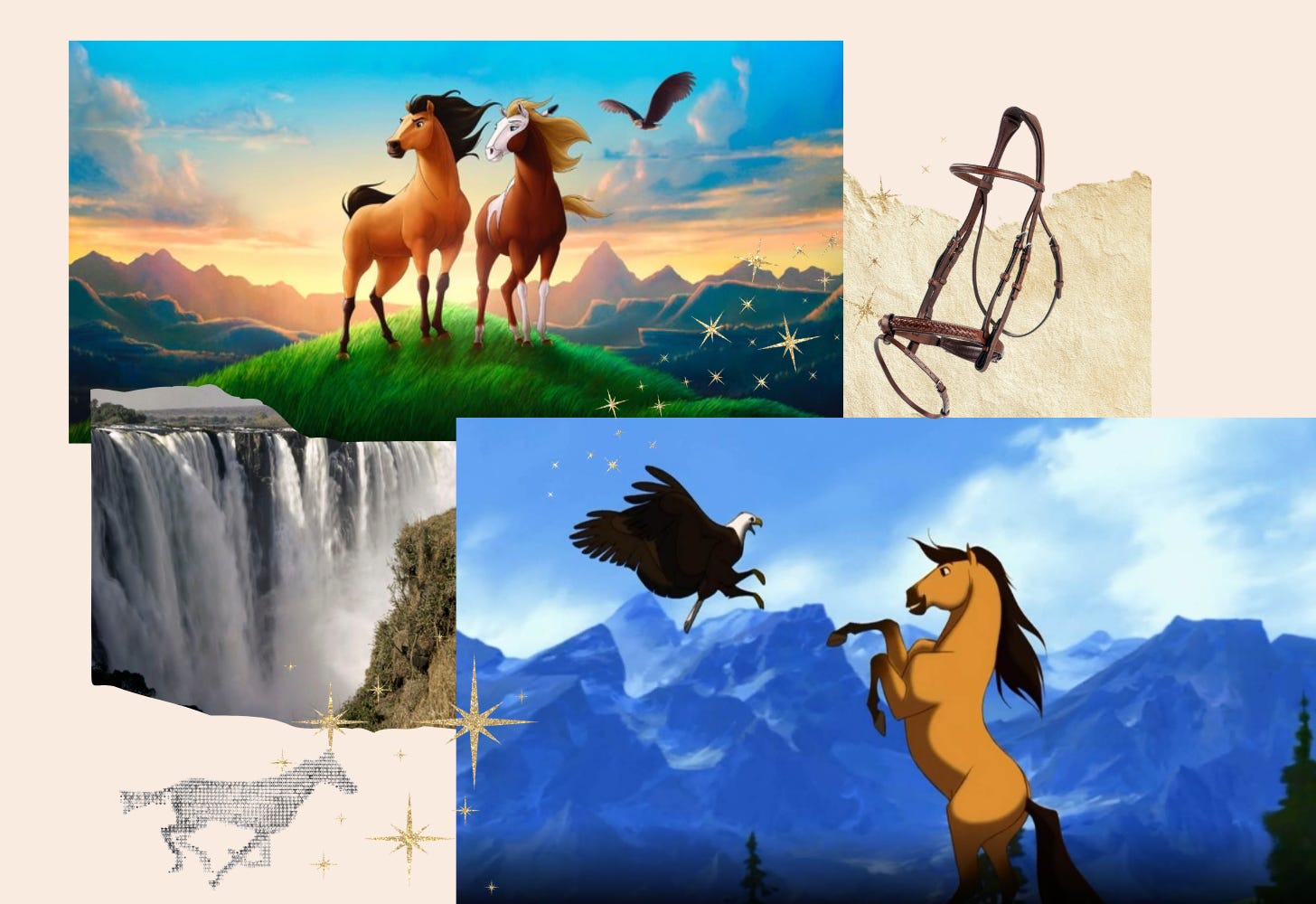
What does it feel like to be a horse?
I think Spirit is an interesting example in two ways.
First, the movie is basically silent. You hear the settlers yell orders here and there, and Little Creek tries to talk a bit here and then, but Spirit doesn’t have language. And yet, through expressive animation and sound design, we understand the horses’ emotions perfectly. This is a completely different way of life, and yet it’s somehow legible on the screen. We understand the herd dynamics, we see Spirit fall in love with a mare, we feel the pain and fear when he escapes with Little Creek.
Compassion involves the recognition that another person, in some ways similar to oneself, has suffered some significant pain or mis- fortune in a way for which that person is not, or not fully, to blame. As many moral traditions emphasize [...] it requires estimating the significance of the misfortune as accurately as one can – usually in agreement with the sufferer, but sometimes in ways that depart from that person’s own judgment.
Second, while Spirit mostly makes choices that are “a human in a horse skin”, like trying to save himself, making friends with other horses, refusing to be beaten, … He also makes some that aren’t so straightforward.

I remember that I struggled a lot with how harsh Spirit was with Little Creek, the Lakota man he escapes with. Little Creek is perfectly nice to Spirit, gives him shelter, apples, water – everything a horse needs. But when Little Creek goes to brush his mane, Spirit rears. And when he tries to ride Spirit again, Spirit throws him to the ground. It doesn’t matter that they escaped torture and jail together, Spirit is a wild animal and behaves as such.
Compassion involves the recognition that another person, in some ways similar to oneself, has suffered some significant pain or mis- fortune in a way for which that person is not, or not fully, to blame. As many moral traditions emphasize [...] it requires estimating the significance of the misfortune as accurately as one can – usually in agreement with the sufferer, but sometimes in ways that depart from that person’s own judgment.
As an adult, with somewhat-functioning empathy levels, I understand why Spirit behaves that way, and the message behind it; but as a kid I couldn’t wrap my head around it. The movie definitely helped me understand there were alien perspectives in this world, things that I couldn’t really understand and predict, and that it was ok to let them be.
Right now, that collective muscle is atrophying. Animal populations are plummeting, yet much of the world still treats nature as a backdrop, a resource, or somebody else’s problem. When I take over my cousin’s education on Wednesdays, the most powerful tool I have to reinforce this isn’t a lecture on extinction [7], but a story that puts them in the shoes of a non-human heart for an afternoon.

Noble savages in a noble land
Martha Nussbaum’s argument is about novels and literature. She makes a distinction between the tragedies of old, which concern themselves with tragic heroes, demi gods, and high-level morals; and the contemporary novels (and movies, I’d argue) who deal in ordinary people living ordinary lives.
In reading a realist novel with active participation, readers do all that tragic spectators do – and something more. They embrace the ordinary. They care not only about kings and children of kings, but about David Copperfield, painfully working in a factory, or walking the twenty-six miles from London to Canterbury without food. Such concrete realities of a life of poverty are brought home to them with a textured vividness unavailable in tragic poetry.
Of course, when the matter is “normal people”, the stories necessarily carry the stereotypes and blind spots of their authors. Everyone agreed you shouldn’t kill your dad, not everyone thinks all people are equal.
When we read a novel with close attention, we frequently will be led by the text to have sympathy with characters of many different kinds; but frequently, too, the text will cultivate sympathy unevenly, directing our attention to some types of human beings and not to others. Literary works are not free of the prejudices and blind spots that are endemic to most of the political life.
Which is exactly why Spirit was a risky choice, and I knew it as I pressed play. I love that film, but I dimly remembered my grandmother once sat me down to explain the actual Lakota history the movie left out.
To be completely honest, I was frightened of what twenty years might have done to it. I dreaded finding it cruder and more casually racist than the version I’d kept in my head (cough harry potter cough). You don’t get to pre-screen your own childhood; I was going to find out at the same time my cousins did.
Not that I mind teaching about colonization – I knew I’d need to pause the movie to deconstruct caricatures here and there. As far as 2002 representation goes, Spirit easily clears the bar many tripped over: the Lakota are brave, respectful, and the film doesn’t shy away from the brutality of the colonizers.

However, it leans heavily on the well-meaning “ecological Indian” trope. The Lakota, the horses, and the landscape all share the exact same flawless virtue. Nature isn’t a real place anymore but a moral position: wildness (good) vs. machines and the railroad (bad).
And what does that position look like? Eden. The plains are endlessly green, untouched by drought, starvation, or cruel winters.10 It’s an innocent paradise where the only threat is colonizers, and the only solution is their departure.
Ultimately, that is the film’s most dated concept: the idea that nature is a perfectly stable entity just waiting to be left alone. Because sadly, that is not the reality of the natural world I have to hand down to my cousins today.
To simplify – because that’s how the children saw it – Spirit says be a wild thing and don’t let them break you. It’s a wonderful story, but I’m not sure it’s the one kids need today. Paul Watson was a rebel in his time, but nowadays, we don’t need climate change activists to harpoon whaling ships (or do we? Idk, i didn’t think about this enough, maybe Greta is onto something). What I’m trying to say is that my little cousins aren’t gearing up to become eco-terrorists (affectionate, I like Greta), and are much more likely to get into education, medicine or journalism.
Nature Isn’t Innocent Anymore
That morning had been one of the truly hot ones. The kind where the kids starfish-spread on the tile floor while begging for ice-cream.11 They asked why it was so hot, and because I remember how bad it felt to be talked down to, we ended up going the whole way around the planet. I drew El Niño and the melting of the Arctic badly on the back of an envelope. We talked about jet streams, warming oceans, and eventually climate change and its human origin.
Then 4pm rolled around, and I put on a movie about a perfect green world, where nature is fruitful and only becomes dangerous when humans disturb it, like that time Spirit has to swim in harsh currents and fall off a waterfall to escape his captors.
I didn’t clock the whiplash until the horses were already on screen: inside is Spirit shivering in the shave, outside is the debilitating heatwave.
Here is the appeal of Spirit: there is a villain with a face and a locomotive, and good guys to root for. When Spirit wrecks the train, the wrong is righted and the plains go back to being a paradise. It’s a beautiful rescue fantasy! It works because the threat is entirely external. Leap the canyon, blow up the train, win.
But there is no train to derail in my cousins’ reality. The nature they’re inheriting is a shifting, struggling, deeply interdependent ecosystem, and their every action is making it worse. That ice-cream probably travelled a few hundred if not thousand kilometers, and our clothes might be second hand, but they’re still releasing microplastics every wash. Not to mention the inordinate amount of water I wasted drawing a cold bath as a pool substitute. There is no single villain to blame, no machine to wreck – there is just an ever so slightly hotter year, followed by an even hotter one.

Children feel betrayed by the future we’re giving them
I had assumed the question was whether to let any of this (*waves hands*) into the room at all, whether a film ought to be allowed to worry them about climate change. But the room isn’t a neutral ground anymore: when Caroline Hickman’s team surveyed ten thousand young people across ten countries in 2021, France among them, most kids were frightened already — 3 out of 4 said the future itself scares them. When asked to describe their emotions, they felt betrayed.
So the fear and anger made a nest in this house before I even picked up the remote. Which turns my question inside out. It isn’t “should I show flawed movies about climate change and nature?” It’s: given that they’re already thinking about climate disasters in an incomplete way (as kids are ought to do), what do the movies do with it once it’s on the screen? Pretend it isn’t there? (no thank you) Show it as realistically as the evening news? (maybe not?) Soothe it? Is soothing even the kind thing to do, if the child has already held their parents’ and teachers’ reassurances up against the weather and seen that they don’t match?
I genuinely don’t know yet. And I’m not being coy for storytelling purposes (although I won’t tell you if the cousins are real, or how many of them I have. Stranger Danger and all).
Now that I’ve re-watched Spirit, and that a new heatwave is coming, I’m very interested to see what kinds of movies are in the (air-conditioned) cinema for children their age, with representations of nature. I want to know what rehearsals they run on the topic of climate change, and whether any of them has worked out how to tell a child a truth that won’t scare them to death, but also won’t neuter them into useless capitalism-followers.
So that’s the series: one somewhat-recent-film a week for the next three or four.12 I thankfully live in Paris so I have access to re-runs, and I can already tell you we’ll watch, in order, Arco, Flow and Hoppers. I didn’t pick them as a syllabus, or on purpose for this series of posts, but why waste such a good opportunity?13 Maybe I’ll reach the end of the summer and decide the films are fine and I’ve been overthinking, which would be extremely in character.
In the meantime — I’ve shown you my horse. What’s yours? The film you soaked up at eight, before you had enough of a brain to really argue with or for it? I’d love to know! I’m especially curious whether yours had any weather in it…
Stuff I read for this post:
Caroline Hickman (2020), Urgent and immediate danger for IAI (oped)
Caroline Hickman (2020) We need to (find a way to) talk about … Eco-anxiety, Journal of Social Work Practice (actual study)
Martha Nussbaum, Cultivating Humanity (1997). All quotes in this post are from chapter 314
If you want to read more:
Emily Spinach did an eco-critical reading of The Hunger Games which I loved (behind a paywall sorry, but her stuff is worth it!)
And hopefully I’ll remember to link the rest of my posts on this topic here!
Picture credits:
Stillshots from the movie Spirit, collages by me
Other dividers are stamps I inked and scanned on the computer (can you feel the analog vibes or did I waste three hours?)
See you next week,

Minus the heat—I don’t control the weather, and French people don’t have AC at home.
To this day I still have some sort of hatred for that one babysitter who wasn’t family and therefore followed my parents’ instructions to a T. There’s nothing worse than cutting Bambi off when he’s just discovering winter and taking a bad fall!
granted, some scenes are a bit scary for a 6 years old, but i checked on the internet and wikipedia said it was fine!
It was a bizarre experience re-watching the movie in English instead of my native French (i’m exposing the children to English). There isn’t much dialogue, as I said, but when Spirit befriends Little Creek or the settler villains yell orders, I instinctively recoiled. These childhood movies are so deeply tied to their French voiceovers for me. I need to write a full essay about this one day.
I would be remiss not to mention The Saddle Club as well for pushing me into my equestrian era -- although the French translation of it was “full speed canter” which is so much more enticing!
omg i’ll be 45 then 😱 here comes the second existential crisis, i still can’t believe the kids were born AFTER 2015!
No bashing the parents in any way! I’m sure i’d have the same policy if they were my own. And they’re doing plenty of efficient storytelling through books!
To be honest, I read articles about the philosophy, rarely the philosophy itself because I’m ever so slightly not fluent enough in English to read them, and I’ve lost all my reading muscles in French. I should spend more time in my native language, it’s disheartening to see I can’t focus on a theoretical book in French anymore.
Don’t get me started on animal intelligence, we’re been willfully underestimating them on purpose to exploit them imo
Although I've recently read this great article (in French AND paywalled, I'm so sorry) about how the "old world" did indeed look like this.
I was always confused how people going on huge trips to colonize America didn't starve to death when it takes several hours to catch the one fish -- but actually the salmon really was that abundant in their time!
I do follow the parents’ dietary restrictions, and sadly but understandably we’re only allowed one sorbet a day
i don’t really know when school starts up again, and i love you all but i can’t be bothered to check my calendar for that.
Although now that I think of it, someone probably did mean it as a syllabus, seeing as they’re all not-brand-new movies about climate change… I might be a bit naive on the side, but that’s why you love me, isn’t it?
The rest of the book is also really interesting. The main questions are: what does it mean to be a citizen of the world? and how does one raise children to be good citizens?